Growth and Attraction – Lecture 6

Growth and attraction

Good lesson from the course and mentioned before in my blog posts, when starting a startup you should not focus on competition. You should be aware of what your competition is doing, but your competition should not be the base of what you are doing. You need to think about your customer and how to create ten times the value. The thing is that when you become successful, people will start copying what you are doing, and that is when you need to get paranoid and keep on innovating. The competitive advantage you gain from value creation and excellent product development will buy you some time and money to innovate.

We had a great guest lecture from Xiaochen the co-founder of Guide to Iceland, where she discussed the growth of a startup. The lecture was not only practical but also motivating as Guide to Iceland have recently been through the process, from startup to a successful business.

She began her lecture by talking about consumers. Travelers today don’t want to be called tourist, they want to be called travelers and get local. This was (or is) their concept. When starting out, they were thinking about travelers not about the business. Because when you are starting a business you need to think in value, when you have value then people will come to you (pull strategy). Networking effects come from true value. She found it critical to think about the bigger community. Everyone in Iceland want to take a piece of the tourist industry in Iceland. Last year around 1.500.000 tourist came to Iceland, where only 300.000 people live. If you don’t get networking effect in the tourist industry you will have a difficulty. By putting up a community, solving problems, adding value, you will increase your changes of getting networking effect. One other strong point in value creation is that if you create value for your customers, they will be willing to pay the margin.

One part of growing is hiring new team members and spreading the responsibility. When looking for team members she found it important to look for people that will make through the hard work emotionally. The lack of sleep alone will make you very edgy. It is important for the startup to hire the right employees and it is import for the employees that their co-workers find out what motivates them, what makes them happy and what their mission is (motivation and appreciation). You should definitely not hire cheap, it is very hard to deal with frustration of employees and if you don’t have the money you should think about other things that the employees might be interested in.

In my past blogs I have been writing a lot about lecture where the importance of building great products and problem solving have been given some thought. Now I think it’s time to quote the Startup Iceland Blog, traction trumps everything.
“Getting to traction is not a function of money, although in some cases it could be. Time and time again I have found startup founders not focusing on this. Building a great product is important and solving a big problem is also important, but all that would be moot if you are not able to show growth.”

Makes sense doesn’t it?

19 channels to reach to your customers:

  1. Viral Marketing
  2. Content Marketing
  3. Community Building
  4. Engineering as Marketing
  5. Public Relations(PR)
  6. Business Development
  7. Search Engine Marketing (SEM)
  8. Search Engine Optimization (SEO)
  9. Social and Display ads
  10. Offline ads
  11. Targeting Blogs
  12. Email Marketing
  13. Affiliate Programs
  14. Unconventional PR
  15. Speaking Engagements
  16. Offline Events
  17. Trade Shows
  18. Existing Platforms
  19. Sales

http://startupiceland.com/2015/02/03/traction-trumps-everything/
Building Great Products – Lecture 4

Building great products

“Design is not what it looks like and feels like. Design is how it works.”
– Steve Jobs

Every company must have something to offer, some service or product that the customer is willing to pay for. If you build something that customer’s really like, your startup will have something valuable to offer to customers. However, let’s not confuse product vs. business model, those two things are totally different. There are several methodologies to discover a repeatable business model but very few methodologies to build products. The Lean Startup is one of my favourite.

The lean startup starts with an idea, than you start building your product. When building your product you will use tests (unit tests, usability tests), from those tests you will get results and than the next step would be to analyze the data you will get. From your analysis you will get feedback, gain learning and understanding and take that into account when you start developing your product (constant innovation). The Lean Startup is a good model to use in today’s environment where there is need for constant innovation. Today’s customers are very demanding and companies must constantly be innovating and finding strategic ways to deliver value to their customers. If you want to be the leader is space, you need to rethink business from scratch. Apple did not take Nokia phone and ask them selves how do we make it better. They started from scratch.

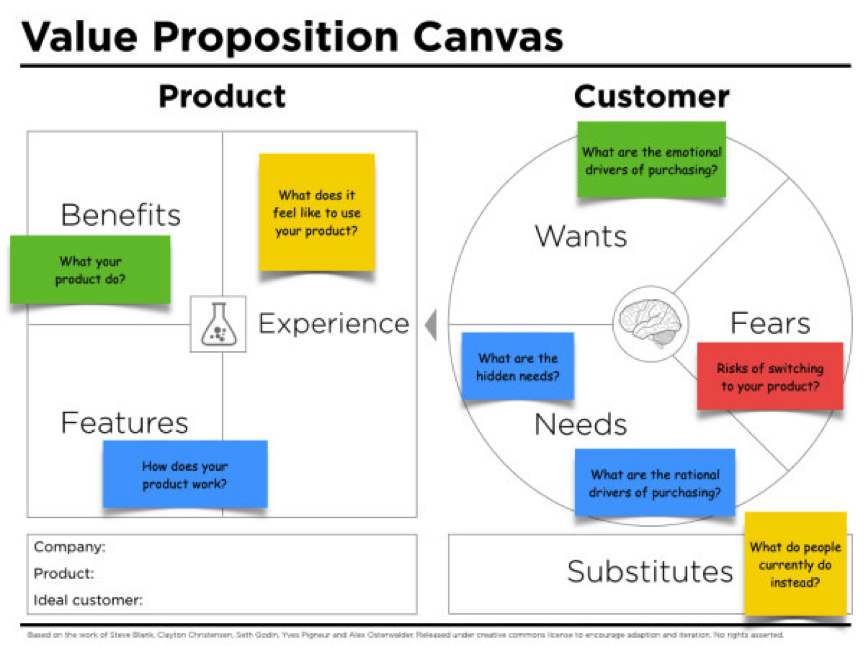
Value is a cornerstone for all business transactions. In order to get part of customer’s wallet, you must offer them some kind of value in return. Value Proposition Canvas is a useful tool for company to use when they are developing a new product or in the middle of a value creation for the customers. The tool is a fantastic to use when looking at the User-Product relationship and that’s why I prefer to have it in mind when blogging about building a great products. The Value Proposition Canvas is a part of The Business Model Canvas invented by Alexander Osterwalder. The Youtube video below (link below) explains The Business Model Canvas in 2 minutes. I highly recommend readers to dig deeper and really go through the canvas with their ideas.
https://www.youtube.com/watch?v=QoAOzMTLP5s

Value proposition canvas.pdf

Value Proposition Canvas –The User-Product relationship.
Let’s first take a look at the customer section. Analyze the customer’s needs, wants and fears. When developing a brand new product, a product that is ten times better than the substitutes product, it’s useful for developers to use the Canvas for analysis. The creator can use the canvas to make analysis of the current substitute product (could be his own product), or the product that the customer currently buys. When finished with his analysis the creator should have the benefit, features and experience of the current product as well as recognizing the current customer wants, fears, and needs (also hidden needs). If the creator is still sure after the analysis that he has a product that is ten times better than the substitutes product, he has most likely built a great product that is going to give him competitive advantage, or his analysis are totally wrong.

“It is very easy to be different, but it is very difficult to be better” – Jonathan Ive

Design Sprints

Design Sprint is a 5-day process where critical business questions are answered. They questions are answered through design, prototyping, and testing ideas with customers. Teams get great data from day 5 (test, feedback, success/failure) which they can use in their advantage (mentioned earlier in the blog). Often times the failures provide the greatest return on investment and it is good for entrepreneurs to do it this way, because they learn it the hard way without the “hard way”, or in other words they don’t have to spend a lot of time or money in order to get those feedback.


Monday – On the first day the team needs to know how to work together. So they divide their parts so each member can do what he does best.


Tuesday – On Tuesday team members will work individually and sketch up their ideas. After sketching, the team will use structured critique and vote for the best ideas.


Wednesday – Now the team has selected a problem or idea they want to work on. Now the team will draw storyboard to prepare for Thursday and select research participants to prepare for Friday’s interviews.


Thursday – Now it’s time for the team to get productive and build a realistic-looking prototype in just eight hours.


Friday – The team will show their prototype to real customers in 1-on-1 interviews.


Build great products and make your customer your ambassadors.

Lecture 5 – Competition and visit to QuizUp

Competition

When building a startup focusing on competition is the worst thing you can do.
You should not focus on competition.
You should be aware of what your competition is doing, but your competition should not be the base of what you are doing.
Economics tells us that competition is a good thing and we should encourage competition. Economic history is rather short so we should be careful of accepting all economic theories. Because we are constantly told that competition is a good thing, we start to believe it. The perception is that all companies are similar and are in competition with their competitors, but the reality is that differences are deep. Some companies are dealing with a lot of competition while others are in a monopoly.

So which is better for startups?

“Creative monopoly means new products that benefit everybody and sustainable profits for the creator. Competition means no profit for anybody, no meaningful differentiation, and a struggle for survival.”
– Peter Thiel

Startups should aim for monopoly. Monopoly gives them competitive edge. It gives them differentiation, they are able to show the consumer true value and sell their products on higher margin. Their high margin (money) will give them time, which is a huge advantage for the company. They can use the money and the time to innovate and make their products better, rethink their business model or strategy, or even start a new startup. All this comes for creating a true value for the consumer and by doing that the startup doesn’t need to worry so much about competition and wasting their energy on thinking about what other companies are up to.

For further understanding on this object, I highly recommend watching this short video clip of Peter Thiel talking about monopoly or reading the chapter: The Ideology of Competition in his book Zero to One.
https://www.youtube.com/watch?v=zI7hbEuopLI

Visit to QuizUp

The class visited the startup QuizUp in Laugarvegur and had a listen to the QuizUp team talking about their learnings in making QuizUp for Android. This was their schedule:
17:30 – Welcome to QuizUp
18:00 – QuizUp for Android Saga
18:15 – Cleaner Code
18:30 – RxJava in Android land
18:45 – Couch to 65k
19:00 – Q&A

I enjoyed the visit although I did not understand what the programmers were talking about. The visit gave me an insight into the Programmers culture, how they like to work, what it is that they are really doing, how they think and what they like to do at work. For example I learned that if you give programmers some free time to hold a “hackathon” they will be very pleased. My major is Marketing and for obvious reasons this is not taught in marketing. However it is important to know. In the near future I will probably be work with Programmers and it is important for me to be able to understand them and work with them. I believe that after our visit to QuizUp my communications with the programmers will get better then it has been in the past.

Team building – Second lecture

Idea, product, team and execution. Those are the four things that every startup must have. As taught in second lecture, when you start something the first and the most crucial decision you make is whom to start it with. Furthermore founders should share a prehistory before they start a company together, otherwise they are just rolling dice. In the book Zero to One, Peter Thiel (author and co-founder of PayPal) writes that the reason why the early PayPal team worked well together was because they were all the same kind of nerds. They all loved science fiction and were obsessed with creating a digital currency that would be controlled by individuals instead of governments. Since then the team has become known in Silicon Valley as the “PayPal Mafia” for the reason that they have gone on to help each other start and invest in successful tech companies.

Startups needs structure to decrease the likeness of team members fighting for power. Peter Thiel lines up three concepts to anticipate likely source of misalignments.
– Ownership: who legally owns a company´s equity?
– Possession: who actually runs the company on a day-to-day basis?
– Control: who formally governs the company´s affairs?

Communication is the key, only on paper do the divisions work smoothly and there are no possible conflicts. This is not the reality and that´s why it´s crucial for startups to have structure and for team members to know each other well before they start the startup.

Link to the second lecture -> https://startupiceland.files.wordpress.com/2015/08/hsst-lecture-2.pdf.