Building great products
“Design is not what it looks like and feels like. Design is how it works.”
– Steve Jobs
Every company must have something to offer, some service or product that the customer is willing to pay for. If you build something that customer’s really like, your startup will have something valuable to offer to customers. However, let’s not confuse product vs. business model, those two things are totally different. There are several methodologies to discover a repeatable business model but very few methodologies to build products. The Lean Startup is one of my favourite.
The lean startup starts with an idea, than you start building your product. When building your product you will use tests (unit tests, usability tests), from those tests you will get results and than the next step would be to analyze the data you will get. From your analysis you will get feedback, gain learning and understanding and take that into account when you start developing your product (constant innovation). The Lean Startup is a good model to use in today’s environment where there is need for constant innovation. Today’s customers are very demanding and companies must constantly be innovating and finding strategic ways to deliver value to their customers. If you want to be the leader is space, you need to rethink business from scratch. Apple did not take Nokia phone and ask them selves how do we make it better. They started from scratch.
Value is a cornerstone for all business transactions. In order to get part of customer’s wallet, you must offer them some kind of value in return. Value Proposition Canvas is a useful tool for company to use when they are developing a new product or in the middle of a value creation for the customers. The tool is a fantastic to use when looking at the User-Product relationship and that’s why I prefer to have it in mind when blogging about building a great products. The Value Proposition Canvas is a part of The Business Model Canvas invented by Alexander Osterwalder. The Youtube video below (link below) explains The Business Model Canvas in 2 minutes. I highly recommend readers to dig deeper and really go through the canvas with their ideas.
https://www.youtube.com/watch?v=QoAOzMTLP5s
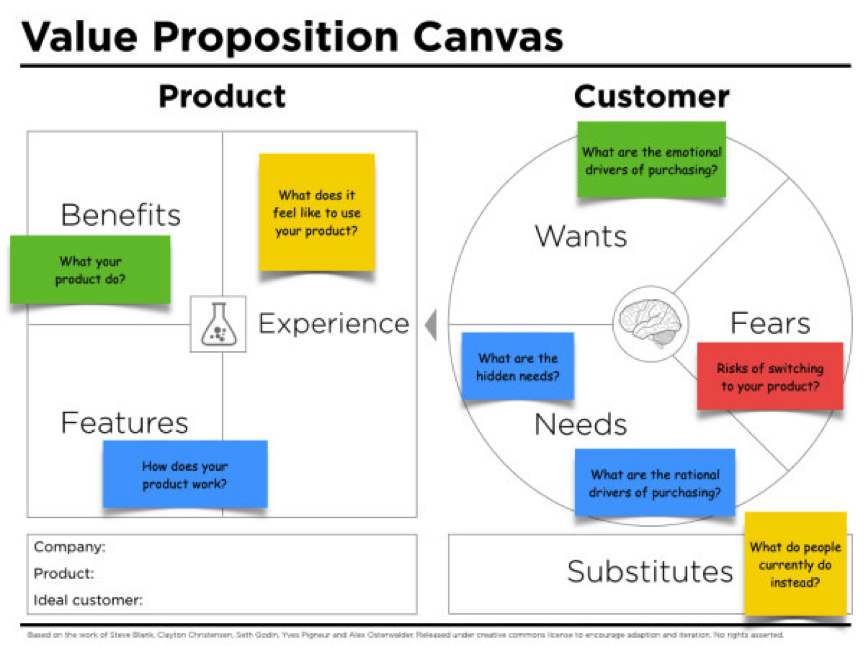
Value Proposition Canvas –The User-Product relationship.
Let’s first take a look at the customer section. Analyze the customer’s needs, wants and fears. When developing a brand new product, a product that is ten times better than the substitutes product, it’s useful for developers to use the Canvas for analysis. The creator can use the canvas to make analysis of the current substitute product (could be his own product), or the product that the customer currently buys. When finished with his analysis the creator should have the benefit, features and experience of the current product as well as recognizing the current customer wants, fears, and needs (also hidden needs). If the creator is still sure after the analysis that he has a product that is ten times better than the substitutes product, he has most likely built a great product that is going to give him competitive advantage, or his analysis are totally wrong.
“It is very easy to be different, but it is very difficult to be better” – Jonathan Ive
Design Sprints
Design Sprint is a 5-day process where critical business questions are answered. They questions are answered through design, prototyping, and testing ideas with customers. Teams get great data from day 5 (test, feedback, success/failure) which they can use in their advantage (mentioned earlier in the blog). Often times the failures provide the greatest return on investment and it is good for entrepreneurs to do it this way, because they learn it the hard way without the “hard way”, or in other words they don’t have to spend a lot of time or money in order to get those feedback.
Monday – On the first day the team needs to know how to work together. So they divide their parts so each member can do what he does best.
Tuesday – On Tuesday team members will work individually and sketch up their ideas. After sketching, the team will use structured critique and vote for the best ideas.
Wednesday – Now the team has selected a problem or idea they want to work on. Now the team will draw storyboard to prepare for Thursday and select research participants to prepare for Friday’s interviews.
Thursday – Now it’s time for the team to get productive and build a realistic-looking prototype in just eight hours.
Friday – The team will show their prototype to real customers in 1-on-1 interviews.
Build great products and make your customer your ambassadors.
 hr1bergs