Guest lecture – Paula Gould – How to get eyeballs on your genius idea!
Paula’s guest lecture was about PR and as it was about PR, the first thing she mentioned was the word ‘story’, “your story is your everything”. Public relations are a lot about communications and story telling. If you have an interesting story, people will want to hear about it, and/or read about it. Other crucial things when working with PR firms or working on PR your self are:
– To know your product, service and offerings.
– Know your market fit.
– Know your industry.
The thing that Paula mentioned here that caught my interest was about the market fit. People or companies tend to think that they are totally unique in the market and that they don’t have any special ‘market fit’. That’s most likely not true. She mentioned that she was working in the entertainment industry earlier in her career and often times the artist had much difficulties finding their market fit. The thing is that it is crucial to position yourself in the market, you must have an vision on how you want people to look at your brand.
People have a lot of choices in the competitive environment these days, so you better find a way to differentiate. As a entrepreneur you should ask yourself these questions:
– How is your service/product different?
– What is better?
– And maybe more important, what is not better?
The media is going to find out what is not better about your product so it is better if you know about before they do.
Shortly after Paula’s lecture I saw an interesting post on the Facebook group “íslenskir frumkvöðlar” (Icelandic entrepreneurs). There was one girl who posted this picture.
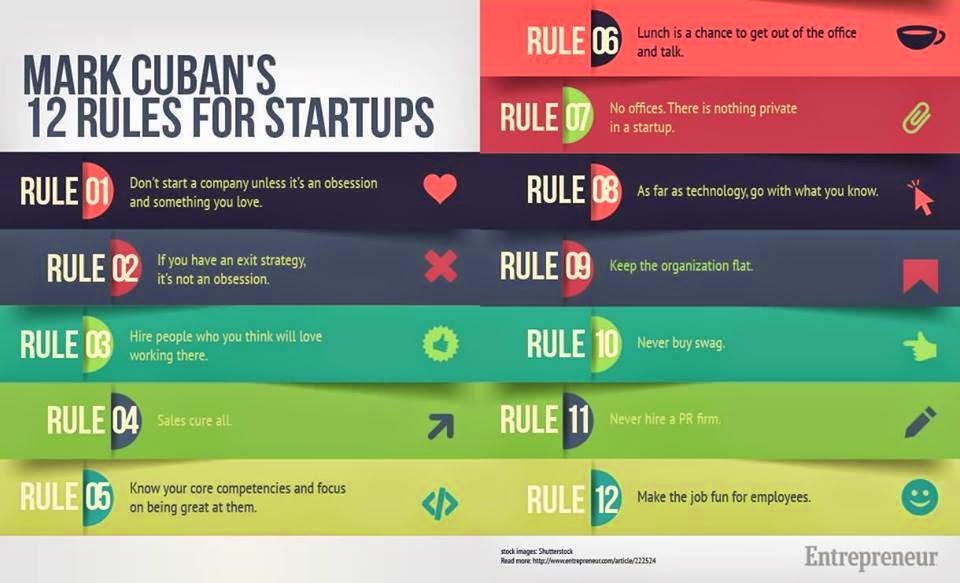
This picture is Mark Cuban’s 12 rules for startups. As you can see the rule number 11 is that you should never hire PR firm. Cuban’s argues that it is more personal for the customer to get the companies messages straight from the founders instead of some PR company communicating the messages.
I didn’t ask Paula about her thought on this matter as I saw this post afterwards. However, her answer to the question if you need a PR firm or not was; that it depends on various things, like:
– Do you stand out on your own?
– Do people know your story?
– Do you have media relationship (she found this crucial)?
– Do you have a product/market fit?
– Are you spending all of your time on development?
– Are you spending any time gaining market reach?
– Do you have someone on your team with PR experience?
So if you are in a startup but don’t afford PR firm, what is it you can do?
– Build it into your budget (funding, equity …), hire someone who is good in PR.
– Be resourceful (use what you have). Your friend and team are your PR. Follow journalist covering competitors and the industry. Follow influencers (even competitors). Engage in conversation and develop a network. Set aside time in calendar for pitching and attend events.
After all, PR is input into your startup pitch.
Lecture from Bala
This lecture from Bala was great. I specially liked when he talked about things you should encourage in your startup and things you should avoid when talking to investors.
In the beginning of your startup journey, you should do things manually until it makes no sense or you have enough cash coming in that you can afford to automate. What you should really be doing is to engage with the users. This is the part of doing things that don’t scale. Avoid hiring people until you have a market fit and always make sure to engage with your users, although they might only be five.
Almost every startup example that we can use did something that did not scale in the beginning; Airbnb, Facebook, DoorDash, Buffer.
Raising money takes a lot of time and effort. This should not be the priority. The priority should be to create something great and valuable. When you raise money you are giving up equity. Typically when you don’t have a market fit you are giving too much equity. Investors want more of a company that don’t have a market fit, and is not making money, this should be rather obvious and simple. So two points to consider before you go and raise money:
1. You give too much of your company to investors.
- It’s distracting what you really should be doing, which is building something great and getting to know your customers.
Whatever you do and whatever your choice is, don’t ever go to investor and say “I have this brilliant idea, please give me your money so I can make it happen.”
The Investor wants value and you have to delay the process as much as you can. One way of creating value is to build a traction machine. The minute you got traction then the investors will be pounding on your door trying to invest. The dream situation is to get the investors to knock on your door instead of you knocking on theirs. If your traction machine doesn’t generate money for the startup immediately, it will at least generate customer base. Than it’s up to the founders to figure out the business model of their startup and start generating some revenue. When the startup start generating revenue, the crucial thing, and specially for Scandinavian entrepreneurs (because they tend to do this), is to not get to happy with the startup’s success. The work has just begun.
Startup Iceland 2015 – Charmaine Li – How should a Startup engage with the Press and Media
I watched the video of Charmaine Li on Startup Iceland the other day, made some notes and now decided to post them to this blog. Her talk was about PR and that’s why these notes are good fit to my post.
First things first. Why do you want the press?
The press can be good for example…
– User/customer acquisition
– Brand awareness
– Attract funding
– Attract talent/key hires
Think about this before you approach any journalist at all. This can help your strategy and helping you achieving your goals.
What is in journalist mind…
– They get a lot of communications (input) from variety of channels.
– They are looking for needle in a haystack.
– They are looking to reach the readers, audience, not themselves.
How do you become the needle in the haystack?
– No right way.
Don’t assume that because your product exists, it’s newsworthy.
– Your blood and sweat are in this product. It’s your baby. But this point is similar like posting baby photo on Facebook.
Think about why your product/service matter. Put your product in context. What makes your product different from other competitors.
This brings the human touch to it.
When you are telling your story it’s important to have it clear and short. Simple. They don’t want to read your startup novel/journey.
Don’t mass-send generic pitches. Innovative, game-changing (this is out). What you want to do is stand out somehow. Keep it simple. Try to not have it to formal.
Get to know the publication you are getting in to, what they stand for and what audience they are trying to reach to. To they focus on certain market or industry.
Do: Build up relationship and be personal with the press.
Start up building relationship before you build up press coverage.
If you met the writer before, mention that in your e-mail. Make an extra effort. It can make a difference.
 hr1bergs